
Ephesus in the Bible: The Most Important Biblical City Outside Jerusalem
No ancient city outside Jerusalem played a greater role in the story of early Christianity than Ephesus. Mentioned more than 20 times in the New Testament, Ephesus served as the base for the Apostle Paul's longest missionary stay, the destination of one of Paul's most profound letters, and one of the Seven Churches of Revelation. It is also the city where tradition holds that the Apostle John brought the Virgin Mary, where the Gospel of John was written, and where a landmark church council declared Mary the "Mother of God" in 431 AD.
Today, visitors to the archaeological site of Ephesus near Selcuk, Turkey, can walk the very streets where Paul preached, stand in the Great Theatre where a riot erupted over his teaching, and visit the Basilica of St. John on Ayasuluk Hill. This guide explores every biblical connection to Ephesus, from Paul's three-year mission to the apocalyptic warnings of Revelation, and shows you exactly what to see when you visit.
Paul's Three Years in Ephesus (Acts 19-20)
Arrival and Early Ministry
The Apostle Paul first passed through Ephesus briefly at the end of his second missionary journey (Acts 18:19-21), leaving Priscilla and Aquila there. He returned during his third missionary journey and stayed for approximately three years (Acts 20:31) — the longest he spent in any single city. This extended stay, roughly from 52 to 55 AD, transformed Ephesus into the most important center of Christianity in Asia Minor.
When Paul arrived, he found about twelve disciples who had received only the baptism of John. After Paul laid hands on them, the Holy Spirit came upon them, and they spoke in tongues and prophesied (Acts 19:1-7). This event marks the formal establishment of the Ephesian church.
The School of Tyrannus
For three months Paul debated in the synagogue, but when opposition grew, he moved to the lecture hall of Tyrannus (Acts 19:9). According to one manuscript tradition, Paul taught there daily "from the fifth to the tenth hour" — that is, from 11 AM to 4 PM, during the midday break when the hall was available. He continued this for two years, with the result that "all the Jews and Greeks who lived in the province of Asia heard the word of the Lord" (Acts 19:10).
Extraordinary Miracles
Ephesus was famous throughout the ancient world as a center of magic and the occult. The so-called Ephesia Grammata — magical formulae associated with the city — were renowned across the Mediterranean. Into this environment, God performed "extraordinary miracles" through Paul: even handkerchiefs and aprons that had touched him were taken to the sick, and their illnesses were cured (Acts 19:11-12).
The Seven Sons of Sceva
The power of these miracles attracted imitators. Seven sons of a Jewish chief priest named Sceva attempted to invoke the name of Jesus over a demon-possessed man. The evil spirit replied, "Jesus I know, and Paul I know about, but who are you?" and the possessed man overpowered all seven of them (Acts 19:13-16). This dramatic event sent shockwaves through Ephesus.
The Burning of the Magic Books
The incident with Sceva's sons triggered a mass conversion. Many who had practiced sorcery publicly burned their scrolls. Luke records that the value of the destroyed books totaled 50,000 silver drachmas (Acts 19:19) — an enormous sum equivalent to roughly 137 years of a laborer's daily wage. This bonfire of occult literature was one of the most dramatic moments in the history of the early church.
The Riot of the Silversmiths (Acts 19:23-41)
Paul's success threatened the economic engine of Ephesus: the Temple of Artemis, one of the Seven Wonders of the Ancient World. A silversmith named Demetrius, who made silver shrines of Artemis, incited his fellow craftsmen by warning that Paul's preaching endangered both their livelihood and the goddess's honor.
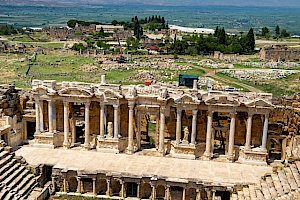
The crowd rushed into the Great Theatre — a magnificent structure that seated 25,000 people and which visitors can still see today — shouting "Great is Artemis of the Ephesians!" for two hours. Paul wanted to address the crowd, but the disciples restrained him. Finally, the city clerk (grammateus) calmed the assembly, warning that Rome might revoke Ephesus's privileged status if the disorder continued (Acts 19:35-41).
"The God who made the world and everything in it is the Lord of heaven and earth and does not live in temples built by human hands." — Acts 17:24 (Paul's approach to pagan cities)
Paul's Farewell to the Ephesian Elders
On his final journey to Jerusalem, Paul summoned the elders of the Ephesian church to meet him at Miletus. His farewell address (Acts 20:17-38) is one of the most moving passages in Acts. He reminded them of his three years of service, warned of "savage wolves" who would enter the flock, and committed them to God. "When he had said this, he knelt down with all of them and prayed. They all wept as they embraced him and kissed him" (Acts 20:36-37).
The Letter to the Ephesians
Paul's Letter to the Ephesians, written during his imprisonment in Rome (around 60-62 AD), is considered one of the theological masterpieces of the New Testament. While some scholars debate whether it was a circular letter to multiple churches, its connection to the Ephesian community is unmistakable.
Key Themes
- Unity of Jews and Gentiles: Christ has "destroyed the barrier, the dividing wall of hostility" (Ephesians 2:14), creating one new humanity
- The Church as Christ's Body: Believers are "members of his body" (Ephesians 5:30), with Christ as the head
- Spiritual Warfare: The famous passage on the "full armor of God" (Ephesians 6:10-18) takes on special meaning given Ephesus's association with spiritual darkness and magic
- Grace and Faith: "For it is by grace you have been saved, through faith — and this is not from yourselves, it is the gift of God" (Ephesians 2:8-9)
"Put on the full armor of God, so that you can take your stand against the devil's schemes. For our struggle is not against flesh and blood, but against the rulers, against the authorities, against the powers of this dark world." — Ephesians 6:11-12
The metaphor of spiritual armor resonated powerfully in a city where magical practices and pagan worship were a daily reality. When Paul wrote about wrestling against "the powers of this dark world," his Ephesian readers understood this from personal experience.
Ephesus in the Book of Revelation: The Seven Churches
Ephesus holds the distinction of being the first of the Seven Churches addressed in the Book of Revelation (Revelation 2:1-7). The risen Christ, speaking through John, delivers a message of both commendation and warning.
Commendation
The Ephesian church is praised for its hard work, perseverance, and intolerance of wickedness. They had "tested those who claim to be apostles but are not, and have found them false" (Revelation 2:2). They also hated the practices of the Nicolaitans.
The Warning: "You Have Forsaken Your First Love"
"Yet I hold this against you: You have forsaken the love you had at first. Consider how far you have fallen! Repent and do the things you did at first. If you do not repent, I will come to you and remove your lampstand from its place." — Revelation 2:4-5
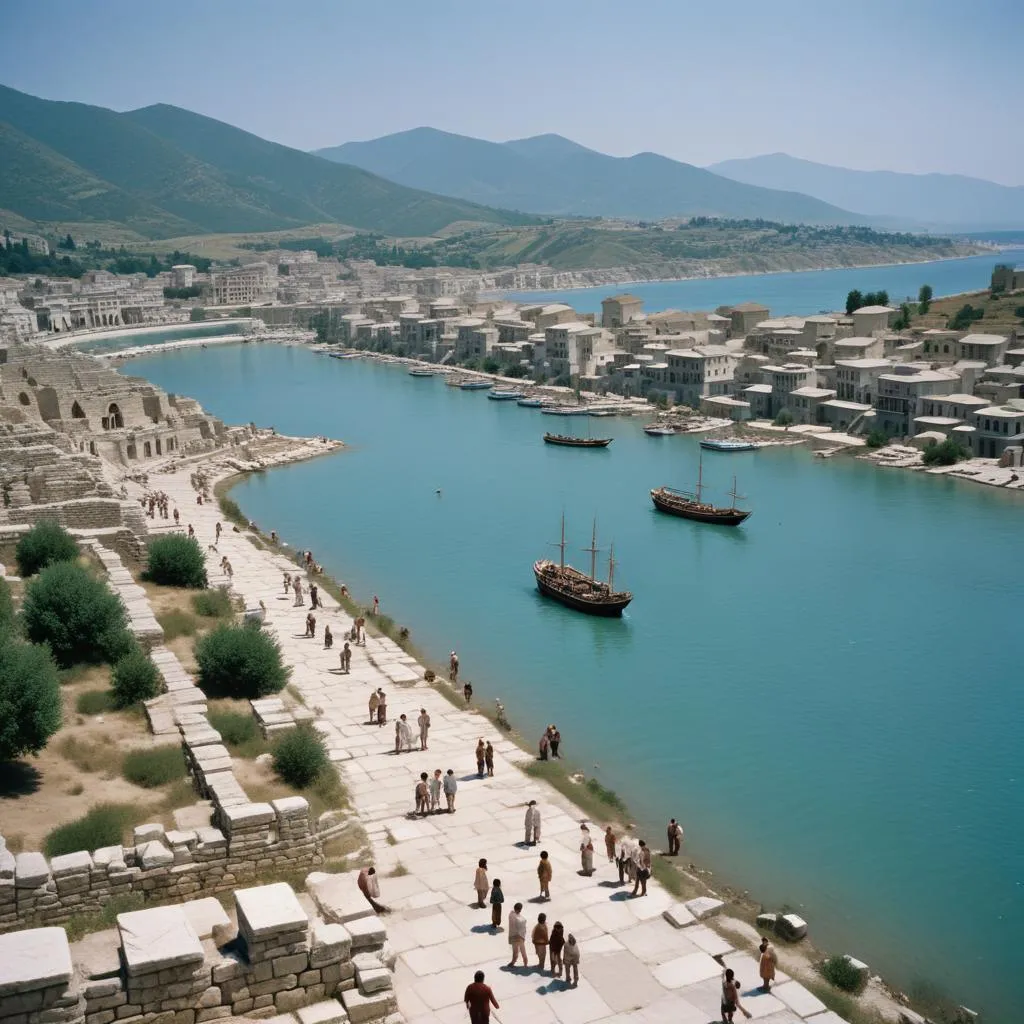
This warning proved prophetic. The once-thriving Ephesian church eventually declined, and the city itself was abandoned by the 15th century as its harbor silted up. Today, the "lampstand" is indeed removed — no Christian community exists at the ancient site. The ruins stand as a powerful visual reminder of this Revelation prophecy.
John the Apostle in Ephesus
Ancient church tradition, supported by early writers such as Irenaeus (who had connections to Polycarp, a disciple of John), holds that the Apostle John spent his final years in Ephesus. According to this tradition:
- John brought the Virgin Mary to Ephesus after the crucifixion, fulfilling Jesus's command from the cross: "Behold your mother" (John 19:27)
- He wrote the Gospel of John in Ephesus
- He wrote the three Epistles of John here
- He received the Revelation while exiled on nearby Patmos island, just 80 km from Ephesus
- He was buried in Ephesus, where Emperor Justinian later built the magnificent Basilica of St. John over his tomb in the 6th century
The Basilica of St. John on Ayasuluk Hill in Selcuk is one of the most important Christian pilgrimage sites in Turkey. Though largely in ruins, the layout of this once-massive church — originally rivaling Hagia Sophia in scale — is clearly visible, and the traditional tomb of John is marked beneath the central apse.
The Virgin Mary and Ephesus
The House of the Virgin Mary
Located on Bulbul Mountain (Mount Koressos), about 7 km from the ancient city, the House of the Virgin Mary (Meryemana) is believed to be the place where Mary spent her final years. The site was discovered in the 19th century based on the visions of a German nun, Anne Catherine Emmerich, and has since been recognized by multiple popes as a pilgrimage site.
Pope Paul VI visited in 1967, Pope John Paul II in 1979, Pope Benedict XVI in 2006, and Pope Francis in 2023. The site features a small chapel that incorporates the original stone walls believed to date to the 1st century, and a sacred spring where pilgrims collect holy water.
The Council of Ephesus (431 AD)
In 431 AD, the city hosted one of the most consequential church councils in Christian history. The Council of Ephesus, the Third Ecumenical Council, convened in the Church of Mary (the Double Church near the harbor) to settle the Nestorian controversy.
The central question was whether Mary could properly be called Theotokos — "God-bearer" or "Mother of God." Nestorius, Patriarch of Constantinople, argued that Mary was only Christotokos (Mother of Christ), separating Jesus's divine and human natures. Cyril of Alexandria championed the Theotokos title.
The council, led by Cyril, declared Nestorius's views heretical and affirmed Mary as Theotokos. This decision profoundly shaped Christian theology and Marian devotion for all subsequent centuries. It is fitting that this council occurred in the city most closely associated with Mary's final years.
What Biblical Visitors Can See Today
Walking through the ruins of Ephesus is a uniquely powerful experience for anyone interested in the Bible. Here are the key sites with their biblical connections:
The Great Theatre
This is where the riot described in Acts 19:29-41 took place. The theatre, which seated approximately 25,000 spectators, has been partially restored and remains one of the most impressive structures on the site. Standing inside it, you can imagine the crowd shouting "Great is Artemis of the Ephesians!" while Paul's companions Gaius and Aristarchus were dragged before the mob.
Curetes Street and the Marble Road
These are the actual streets Paul would have walked daily during his three years in the city. The marble paving stones, worn smooth by millions of ancient footsteps, still bear the marks of cart wheels.
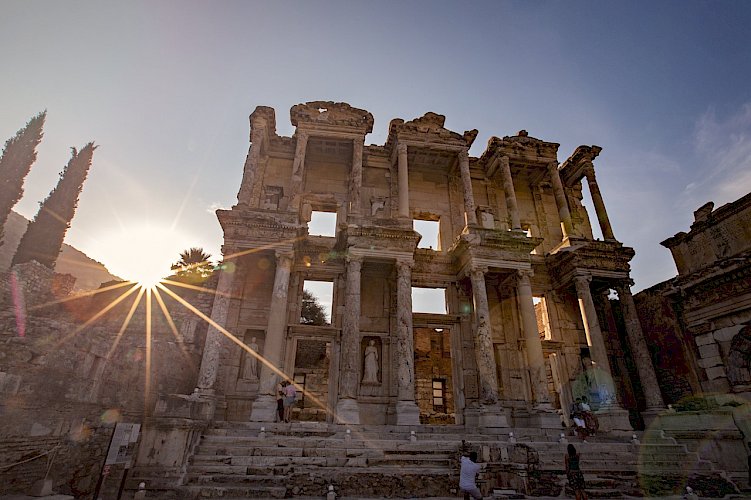
The Library of Celsus
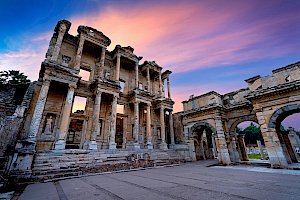
Though built after Paul's time (around 117 AD), this stunning facade stands near the area where Paul would have conducted his ministry. It is the most photographed structure in Ephesus and gives a powerful sense of the city's grandeur during the Roman period.
The Church of Mary (Double Church)
Located near the harbor area, this was the site of the Council of Ephesus in 431 AD. It is believed to be the first church in history dedicated to the Virgin Mary.
The Basilica of St. John
On Ayasuluk Hill in nearby Selcuk, this 6th-century basilica marks the traditional burial site of the Apostle John. Built by Emperor Justinian, it was one of the largest churches in the world at the time.
The House of the Virgin Mary
Located 7 km from Ephesus on Bulbul Mountain, this pilgrimage site is where tradition says Mary lived her final years under the care of the Apostle John. A small chapel, prayer wall, and sacred spring are open to visitors daily.
The Temple of Artemis Site
Only a single reconstructed column remains of the temple that once drove the Ephesian economy and prompted the silversmith riot of Acts 19. Located about 1.5 km from the main archaeological site, it provides context for understanding why Paul's preaching was so threatening to the local economy.
Planning a Biblical Ephesus Tour
Suggested 1-Day Biblical Itinerary
- 8:30 AM — Start at the House of the Virgin Mary (arrive early to avoid tour groups)
- 10:00 AM — Enter Ephesus from the upper (Magnesia) gate, walk Curetes Street
- 10:30 AM — Library of Celsus and the commercial agora area
- 11:00 AM — The Great Theatre — site of the Acts 19 riot
- 11:30 AM — Harbor Street (Arcadiane) and Church of Mary
- 12:30 PM — Lunch in Selcuk
- 1:30 PM — Basilica of St. John and Ayasuluk Fortress
- 2:30 PM — Temple of Artemis site
- 3:30 PM — Ephesus Museum in Selcuk (artifacts from the biblical period)
Practical Tips for Biblical Tourists
- Entrance fees: Ephesus archaeological site is 650 TL (2024), Basilica of St. John is 100 TL, House of Virgin Mary is 150 TL
- Best season: April-May and September-October offer comfortable temperatures
- Guided tours: Consider a guide specializing in biblical history — they can bring the scriptural connections to life
- Bring a Bible: Reading Acts 19-20, Ephesians, and Revelation 2:1-7 on site is a transformative experience
- Cruise visitors: If arriving at Kusadasi port, Ephesus is just 20 minutes away by shuttle or taxi
Frequently Asked Questions
How long was Paul in Ephesus?
Paul spent approximately three years in Ephesus (Acts 20:31), from roughly 52 to 55 AD. This was the longest he stayed in any single city during his missionary journeys. He first visited briefly during his second missionary journey (Acts 18:19-21) before returning for the extended stay during his third journey.
Is Ephesus mentioned in the Book of Revelation?
Yes. Ephesus is the first of the Seven Churches addressed by the risen Christ in Revelation 2:1-7. The church is commended for its hard work and discernment but warned that it has "forsaken its first love." The other six churches — Smyrna, Pergamum, Thyatira, Sardis, Philadelphia, and Laodicea — were all in the same region of western Asia Minor.
Where did Paul preach in Ephesus?
Paul initially preached in the synagogue for three months (Acts 19:8). When opposition arose, he moved to the Hall of Tyrannus (Acts 19:9), where he taught daily for two years. The exact location of the Hall of Tyrannus has not been identified archaeologically, but it was likely in the civic center of the city.
Why is the House of the Virgin Mary in Ephesus?
According to ancient tradition supported by early church fathers, the Apostle John brought Mary to Ephesus after the crucifixion, fulfilling Jesus's command from the cross (John 19:26-27). The house on Bulbul Mountain was discovered in the 19th century and has been visited by several popes.
What happened to the Church of Ephesus?
The warning in Revelation 2:5 — "I will come to you and remove your lampstand" — proved prophetic. The city gradually declined as its harbor silted up, and the population migrated to nearby Selcuk. By the 15th century, Ephesus was abandoned. No Christian community exists at the ancient site today, though active churches serve the small Christian population in modern Selcuk.
Can you visit all the biblical sites in one day?
Yes. The main archaeological site, the Basilica of St. John, the Temple of Artemis site, and the House of the Virgin Mary can all be visited in a full day. Starting early (by 8:30 AM) is recommended to avoid the midday heat and the large tour groups that arrive from cruise ships around 10 AM.