

Exploring Ephesus: A Traveler’s Guide to an Ancient City
Imagine standing on a sunlit marble street, surrounded by towering columns and intricate mosaics, where the echoes of ancient merchants, philosophers, and gladiators seem to linger in the air. This is Ephesus, a city that once rivaled Rome in splendor and significance. Located near the modern town of Selçuk in western Turkey, Ephesus is one of the world’s best-preserved ancient cities, a UNESCO World Heritage Site that invites you to walk through millennia of history. From the majestic Library of Celsus to the sacred House of the Virgin Mary, Ephesus is a treasure trove for history lovers, spiritual seekers, and curious travelers alike. Join us on a journey through time to uncover the stories, sights, and secrets of this extraordinary city.
A Journey Through Time: The History of Ephesus
Early Beginnings
The roots of Ephesus stretch back to the Neolithic Age, around 6000 BC, when early humans settled in the fertile lands near the Cayster (Küçükmenderes) River. Archaeological finds at Arvalya and Çukuriçi höyüks reveal evidence of these early communities. By the Late Bronze Age, the region was home to Apasa, the capital of the Arzawan kingdom, which some scholars link to Ephesus. A Mycenaean burial ground from 1500–1400 BC, discovered near the Basilica of St. John, hints at early Greek influence, setting the stage for the city’s future prominence.
Founding and Growth
Ephesus was formally established in the 10th century BC as an Attic-Ionian colony on Ayasuluk Hill, about 3 kilometers from its later classical center. Legend credits Androklos, an Athenian prince, with its founding, and the city soon joined the Ionian League, a coalition of 12 Greek cities. Its early prosperity was tied to the worship of Artemis, the goddess of fertility, whose temple—completed around 550 BC—became one of the Seven Wonders of the Ancient World. With over 100 marble pillars standing 56 feet tall, the temple took 120 years to build and earned Ephesus the title “Servant of the Goddess.”
Under Persian and Greek Rule
In the Archaic period, Ephesus allied with Lydia but faced challenges, including raids by Cimmerians and a siege by King Croesus. By 547 BC, it fell to the Persians, becoming part of the Achaemenid Empire. The city played a key role in the Ionian Revolt of 498 BC, but after its failure, Ephesus joined the Athens-led Delian League, later aligning with Sparta during the Peloponnesian War. Known for its progressive society and emphasis on education, Ephesus attracted scholars and philosophers.
A dramatic moment came in 356 BC when Herostratus, seeking infamy, burned the Temple of Artemis. The rebuilt temple was even grander, but the act left a lasting mark on the city’s history. The Hellenistic period saw Ephesus under Alexander the Great’s liberation in 334 BC, followed by rule under Lysimachus, who relocated the city due to harbor silting, naming it Arsinoea. It later passed through Seleucid, Ptolemaic, and Pergamene hands before joining the Roman Republic in 133 BC.
Roman Ephesus
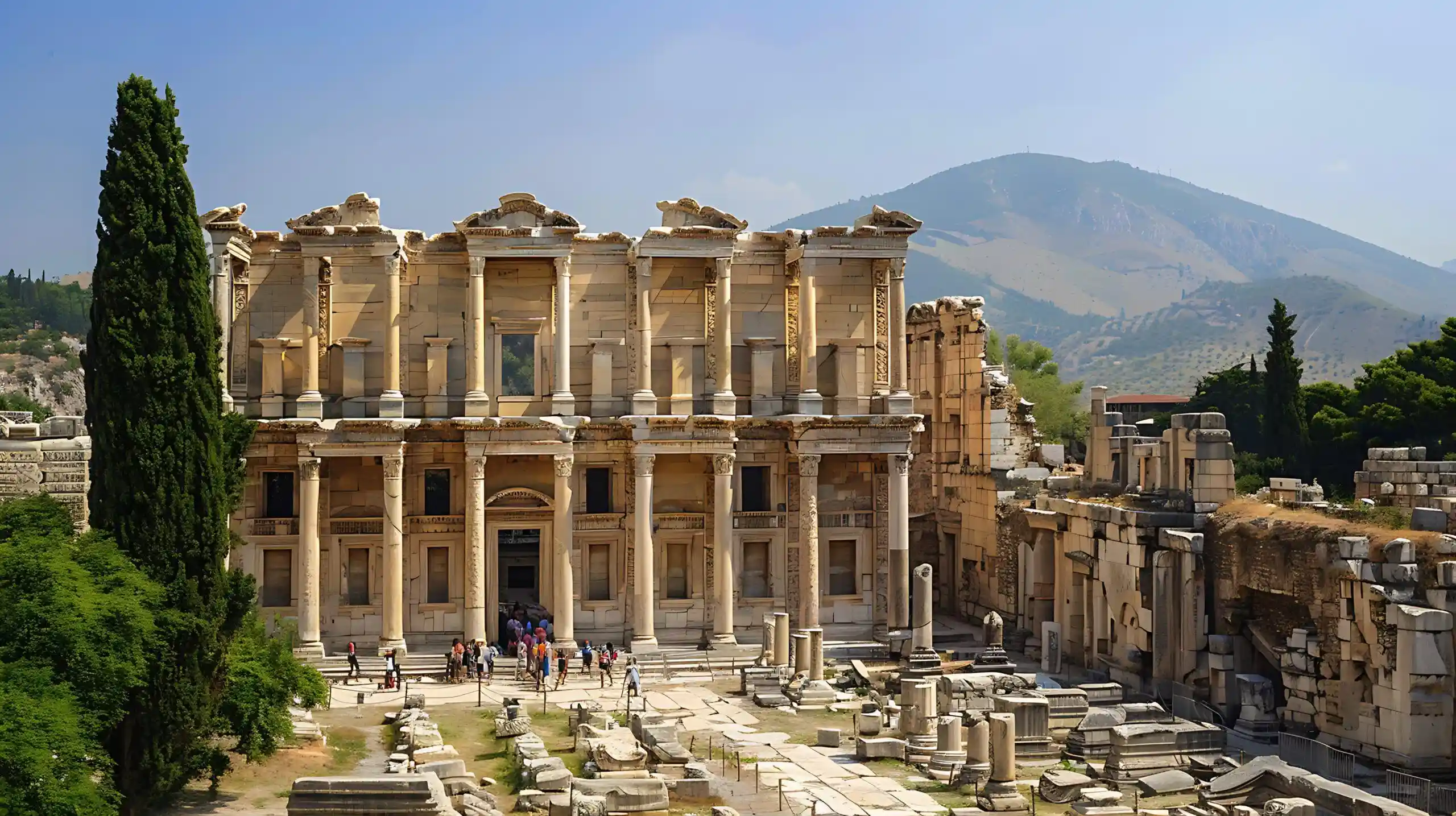
Under Roman rule, Ephesus reached its zenith. As the capital of the province of Asia from 27 BC, it was second only to Rome, according to geographer Strabo. The city’s wealth funded architectural marvels like the Library of Celsus, built around 125 AD to house 12,000 scrolls, and the Great Theatre, seating 25,000. Two agoras—one commercial, one for state affairs—and an advanced aqueduct system powered water mills, including a marble sawmill, showcasing Roman engineering.
Despite its prosperity, Ephesus faced setbacks. In 263 AD, Goths sacked the city, though Emperor Constantine later rebuilt it. Population estimates range from 33,600 to 172,500, reflecting its status as a major urban center. The city’s harbor, vital for trade, began silting up, foreshadowing its decline.
Christian Influence and Decline
Ephesus holds a special place in Christian history as one of the seven churches of Asia cited in the Book of Revelation. Tradition suggests the Apostle John wrote his Gospel here and brought the Virgin Mary to Ephesus after Jesus’ crucifixion, where both spent their final years. The Basilica of St. John, built in the 6th century under Justinian I, marks John’s believed tomb. The city hosted the Third Ecumenical Council in 431, affirming Mary as the “Mother of God,” and the controversial Second Council of Ephesus in 449.
By the 7th century, silting rendered the harbor unusable, and an earthquake in 614–615 devastated the city. Arab invasions in the 7th and 8th centuries further weakened Ephesus, and by the 11th century, it fell to the Seljuks. Despite brief Byzantine recoveries, the city was abandoned by the 15th century, its ruins buried until rediscovery in the 19th century.
Exploring the Ruins: Must-See Attractions
Ephesus today is an open-air museum, with ruins that vividly bring its past to life. Here are the highlights every visitor should explore:
Library of Celsus
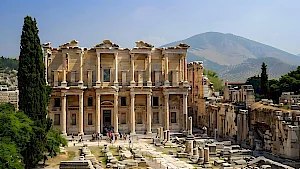
The Library of Celsus is Ephesus’s crown jewel, its reconstructed façade a testament to Roman architectural brilliance. Built in 114 AD by Gaius Julius Aquila for his father, Tiberius Julius Celsus Polemaeanus, it once housed 12,000 scrolls. Four statues symbolizing Wisdom, Knowledge, Education, and Valor adorn the entrance. Damaged in 262 AD, the façade was restored in the 1970s, making it a must-see for its elegance and historical significance.
Great Theatre
Carved into Mount Pion, the Great Theatre is a marvel of scale and acoustics. With a capacity of 25,000, it hosted plays, gladiatorial combats, and public assemblies. A 2007 excavation uncovered a nearby gladiator graveyard, revealing the harsh realities of ancient entertainment. Standing on its stage, you can imagine the roar of the crowd echoing through the ages.
Temple of Artemis
Once one of the Seven Wonders, the Temple of Artemis now consists of a single column amid ruins. Its 127 marble columns, each 60 feet high, symbolized Ephesus’s devotion to Artemis. Though little remains, its legacy endures, and the site evokes the city’s ancient splendor.
Terrace Houses
The Terrace Houses, or “Houses of the Rich,” offer a glimpse into elite Roman life. These six residences, built from the 1st century BC to the 7th century AD, feature mosaics, frescoes, and underfloor heating. Protected by modern roofing, they reveal the opulence of Ephesus’s wealthy, with private baths and marble-clad walls.
Odeon
The Odeon, a smaller theatre seating 1,500, was used for musical performances and city council meetings. Its red granite Corinthian pillars and once-wooden roof highlight its intimate design, contrasting with the Great Theatre’s grandeur.
Temple of Hadrian
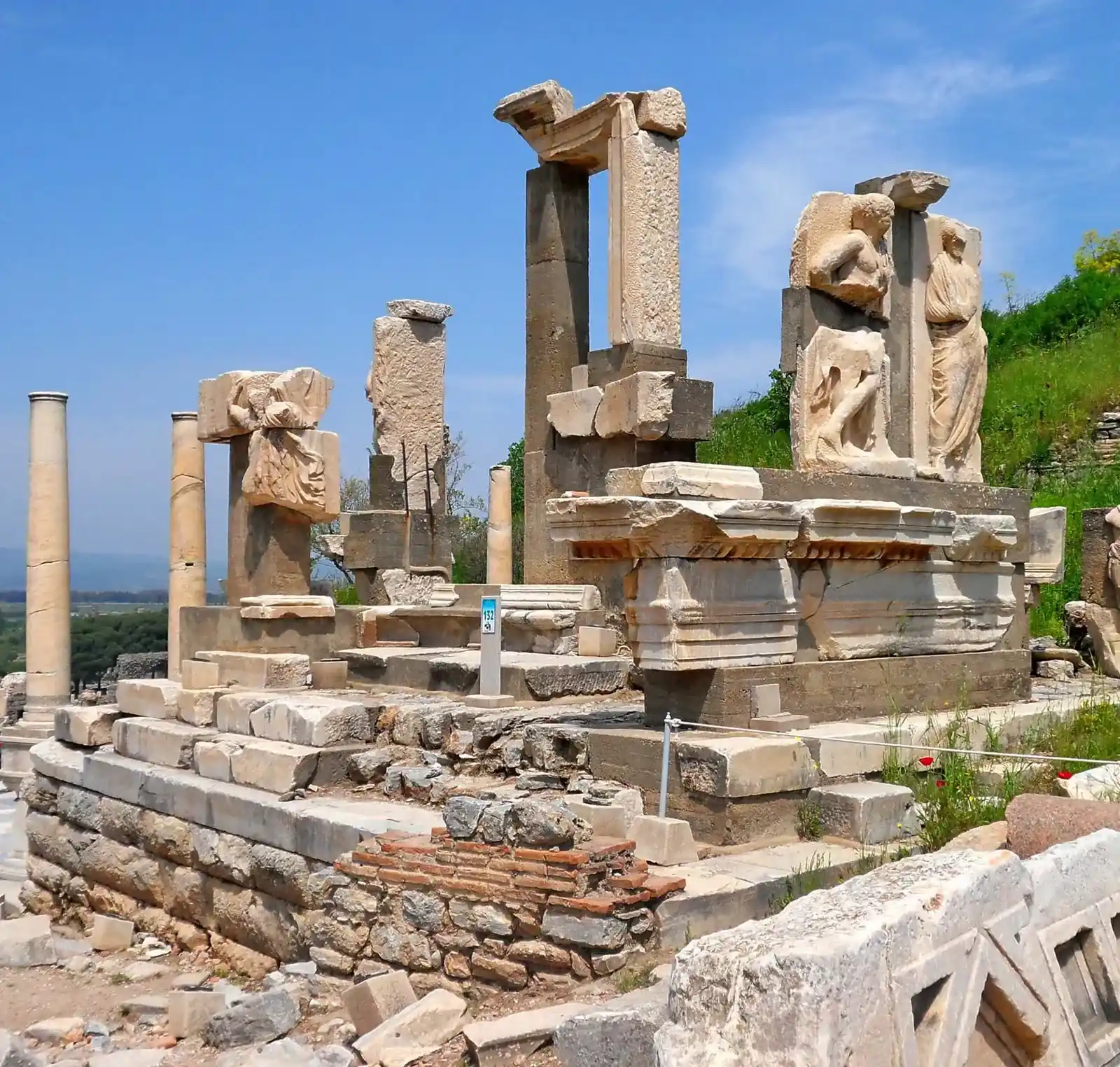
Built in the 2nd century AD, the Temple of Hadrian features intricate reliefs of mythological and historical scenes, including Emperor Theodosius I. Repaired in the 4th century, its partial reconstruction showcases Ephesus’s artistic heritage.
Agoras
Ephesus had two agoras: the Commercial Agora, a bustling marketplace, and the State Agora, for political and official activities. Surrounded by stoas, these spaces were the heart of the city’s economic and civic life.
House of the Virgin Mary
Located 7 km from Selçuk on Nightingale Mountain, the House of the Virgin Mary is a sacred site for Christians. Believed to be Mary’s final home, it was discovered in the 19th century based on visions of German nun Anne Catherine Emmerich. Visited by popes, including John Paul II and Benedict XVI, it remains a place of pilgrimage and reflection.
Other Notable Sites
-
Basilica of St. John: Built over John’s tomb, this 6th-century structure is a testament to Ephesus’s Christian heritage.
-
Tomb/Fountain of Pollio: A 97 AD monument with a concave façade, honoring C. Sextilius Pollio.
-
Church of Mary: Near the harbor, it hosted the 431 Ecumenical Council.
Ephesus Today: A Living Museum
Declared a UNESCO World Heritage Site in 2015, Ephesus spans 662.62 hectares, with ongoing excavations since 1863 uncovering its secrets. Artifacts are displayed at the Ephesus Archaeological Museum in Selçuk, the Ephesos Museum in Vienna, and the British Museum in London. Accessible from Adnan Menderes Airport or Kuşadası’s port, Ephesus is a highlight for cruise passengers and independent travelers. Nighttime visits, enhanced by recent lighting, offer a magical perspective on the ruins.
Practical Tips for Visiting Ephesus
To make the most of your Ephesus adventure, consider these tips:
-
Getting There: From Izmir, take a bus to Selçuk (80 km), or hire a taxi from Kuşadası. Cruise passengers can join guided tours from Kuşadası’s port.
-
Entrance Fees: As of 2025, entry costs 40 Euros per person, with free admission for children under 8 (passport required). Tickets accept Visa and Mastercard.
-
What to Bring: Wear comfortable shoes for uneven terrain, and bring water, sunscreen, and a hat, especially in summer when temperatures soar.
-
Best Time to Visit: Spring (April–May) and fall (September–October) offer mild weather and fewer crowds. Summer brings heat and cruise ship tour groups.
-
Guided Tours: A knowledgeable guide can enrich your experience, sharing stories like the infamous Herostratus or the city’s Christian significance. Book through trusted providers like Visit Ephesus.
-
Additional Sites: Combine your visit with the Ephesus Archaeological Museum, Basilica of St. John, or nearby Şirince village for a full day of exploration.
-
Crowd Management: Arrive early to avoid peak crowds, and visit the Terrace Houses (extra fee) for a quieter experience.
The Enduring Legacy of Ephesus
Ephesus is more than a collection of ruins; it’s a portal to the past, where the stories of ancient Greeks, Romans, and early Christians intertwine. From the awe-inspiring Library of Celsus to the sacred House of the Virgin Mary, every corner of Ephesus whispers tales of triumph, tragedy, and transformation. As you walk its marble streets, you’re not just a visitor—you’re a time traveler, connecting with a civilization that shaped our world.
Plan your visit to Ephesus with Visit Ephesus to uncover the magic of this ancient city. Whether you’re drawn by history, architecture, or spirituality, Ephesus promises an unforgettable journey into the heart of antiquity.
Key Citations:
- Ephesus - Wikipedia
- Ephesus | Ancient City, Turkey & Roman Ruins | Britannica
- Ephesus Ancient City - Ephesus Insider
- Ancient City of Ephesus (2025) - TripAdvisor
- History of Ephesus Ancient City | Best Ephesus Tours
- Ephesus: Exploring an Ancient City - GoTürkiye
- Ephesus Ancient City, Turkey • History & Travel Guide
- Portals to the Past | Ancient City of Ephesus
- Ephesus Ancient City - Best of Ephesus