
Discover the vital role that Ephesus played in Roman history and culture, from its position as a major trade hub to its significance in religion and architecture. Ephesus, located on the Aegean coast of Turkey, was one of the most important cities of the Roman Empire. This ancient city, known for its architectural marvels, rich cultural heritage, and strategic location, became a center of commerce, religion, and politics under Roman rule. As we explore the role of Ephesus in Roman history and culture, we’ll uncover how it shaped and was shaped by the empire that ruled much of the known world.
Ephesus: A Gateway Between East and West
Ephesus thrived under Roman rule largely due to its strategic position along the coast of Asia Minor. Situated near the mouth of the Cayster River, Ephesus connected Asia with the Mediterranean, making it a critical hub for trade and transportation. Roman Ephesus was a bustling port city, where goods from across the empire flowed into Asia, and Asian goods were exported to the West. The city's harbor, combined with a well-developed road network, allowed Ephesus to become a thriving commercial center that attracted merchants, traders, and settlers from across the empire. The city’s prosperity under Roman rule can be attributed to its role in facilitating trade between the eastern provinces and Rome itself. Ephesus’s wealth is reflected in its architecture and public spaces, many of which were funded by wealthy citizens and benefactors eager to demonstrate their loyalty to Rome.
Architectural Marvels of Roman Ephesus
1. The Library of Celsus
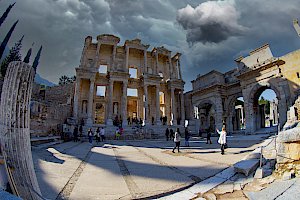
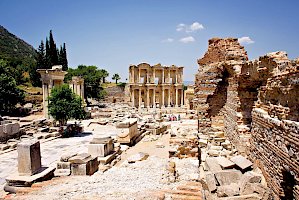
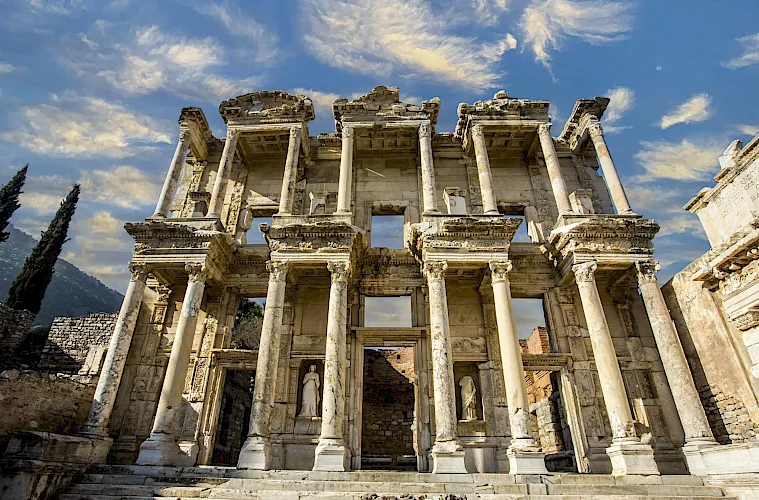
One of the most iconic structures of Roman Ephesus, the Library of Celsus, was built in the 2nd century CE to honor Tiberius Julius Celsus Polemaeanus, a Roman senator and former governor of Asia. This grand library, once home to thousands of scrolls, was not only a center for learning but also a monument to Roman architecture. Its façade, adorned with columns and statues symbolizing wisdom and knowledge, showcases the architectural sophistication of the Roman Empire.
2. The Great Theatre
The Great Theatre of Ephesus, built during the Hellenistic period and expanded by the Romans, could accommodate up to 25,000 spectators. This massive structure served as a venue for public gatherings, theatrical performances, and gladiatorial contests. The theatre is also historically significant as the place where the Apostle Paul is said to have preached to the people of Ephesus, illustrating the city’s role as a religious and cultural center.
3. The Temple of Hadrian
Built in honor of Emperor Hadrian, the Temple of Hadrian is another testament to Roman architecture in Ephesus. The temple’s intricate reliefs and columns are notable for their artistic detail, depicting mythological scenes and symbols of the city’s gods. Temples like this one reflect the integration of Roman imperial cults into the local religious practices, with Ephesians honoring both traditional gods and Roman emperors as divine figures.
4. The Agora and the Harbor
The Commercial Agora and State Agora were focal points of economic and political life in Ephesus. The Commercial Agora, near the harbor, was a bustling marketplace where merchants traded goods from across the Roman Empire. The State Agora served as the city’s administrative center, where political matters were discussed, and public announcements were made. These agoras underscore the role of Ephesus as a city deeply integrated into the Roman economy and governance structure.
The Religious Significance of Ephesus in Roman Times
The Cult of Artemis
Ephesus was home to the Temple of Artemis, one of the Seven Wonders of the Ancient World, which made it a major religious site. Though dedicated to the Greek goddess, the temple held a unique position within the Roman Empire. Ephesus became a pilgrimage destination, where Romans and other worshippers from across the empire came to pay homage to Artemis. The city also held grand festivals and ceremonies in her honor, blending Greek religious traditions with Roman influences.
The Roman Imperial Cult
Under Roman rule, the imperial cult played a central role in Ephesus’s religious life. Ephesians constructed temples and altars dedicated to Roman emperors, whom they honored as gods. These acts of devotion demonstrated the city’s loyalty to Rome and helped integrate Ephesus into the cultural fabric of the empire. The Temple of Domitian, for example, was one of the first temples in Asia dedicated to a Roman emperor, illustrating the importance of the imperial cult in the city’s religious landscape.
Early Christianity in Ephesus
Ephesus is also notable for its role in early Christian history. The Apostle Paul spent several years in Ephesus, where he established a Christian community and wrote his Epistle to the Ephesians. Ephesus is mentioned multiple times in the New Testament, and the Book of Revelation includes a message to the Church of Ephesus. This early Christian presence highlights the religious diversity of the city and its significance as a center for spiritual and theological discourse in the Roman Empire.
Ephesus as a Center of Roman Culture
As a Roman provincial capital, Ephesus embodied the cultural values of the Roman Empire. The city was a place where Greek, Roman, and local Anatolian traditions mingled, resulting in a unique cultural fusion. Public spaces like the theatre, gymnasiums, and bathhouses were places of socialization, entertainment, and leisure, reflecting the Roman emphasis on civic life and public engagement. The wealth and influence of Ephesus attracted artists, poets, and philosophers. This intellectual climate fostered cultural exchange, allowing Ephesus to become a center for art and education. The city’s libraries and public buildings were not only monuments to Roman engineering but also symbols of Rome’s commitment to culture and learning.
Economic Prosperity and Urban Development
Ephesus’s economy flourished under Roman rule, thanks to its position as a trade hub. The city exported goods such as olive oil, wine, and textiles, while importing luxury items like spices, silks, and ivory. Ephesus also became a center for the production of pottery, marble statues, and other goods that were traded throughout the empire. The thriving economy is evident in the city’s opulent residences, public baths, and richly decorated buildings. Urban development projects funded by wealthy Ephesians and Roman benefactors transformed Ephesus into a magnificent city. Structures like the Marble Street and Harbor Baths demonstrated the city’s prosperity and its ability to attract investment from elite patrons. The abundance of luxurious amenities, from public fountains to monumental temples, made Ephesus a showcase of Roman wealth and architectural achievement.
The Legacy of Ephesus in Roman History
Ephesus left a lasting legacy on Roman history and culture. Its temples, libraries, and theatres are enduring symbols of Roman innovation and architectural prowess. As a major city of the Roman Empire, Ephesus exemplified the empire’s ability to assimilate diverse cultures, blending Greek, Roman, and local traditions into a harmonious whole. This cultural synthesis helped establish a shared Roman identity that connected people across vast distances and different backgrounds. The early Christian community in Ephesus further contributed to the city’s legacy. The theological discussions and debates that took place here shaped the development of Christianity, influencing its spread throughout the Roman world and beyond. Today, Ephesus stands as a testament to the complexity and richness of Roman history, drawing visitors from around the world to explore its ruins and experience the echoes of ancient Rome.
Visiting Ephesus Today
Ephesus remains one of Turkey’s most popular tourist destinations, attracting millions of visitors each year. For those interested in experiencing the grandeur of Roman architecture and culture, a visit to Ephesus offers a unique opportunity to walk in the footsteps of emperors, philosophers, and saints. To enhance your visit, consider a guided tour with ephesustours.biz, where you can learn more about the city’s role in Roman history and its enduring cultural impact.
Conclusion
The role of Ephesus in Roman history and culture is marked by its contributions to religion, architecture, and commerce. As a city that connected East and West, Ephesus flourished under Roman rule, becoming a beacon of prosperity and cultural achievement. From its architectural marvels to its spiritual significance, Ephesus encapsulates the grandeur and complexity of the Roman Empire. Today, its ruins offer a window into the past, inviting us to explore and reflect on the legacy of a city that once stood at the heart of ancient Rome’s vast empire.