
Learn about the fascinating story of how modern archaeologists uncovered the ancient city of Ephesus, bringing its legendary ruins back to light. For centuries, the ancient city of Ephesus lay hidden beneath layers of soil and vegetation, forgotten by the world. Once a bustling metropolis and one of the most important cities of the Greek and Roman eras, Ephesus faced centuries of abandonment and decay. However, in the 19th century, modern archaeologists began to rediscover this lost city, and over time, they revealed the architectural wonders, historical treasures, and cultural legacy of Ephesus. This is the story of how Ephesus was uncovered and why it remains one of the most significant archaeological sites in the world.
The Early Quest for Ephesus
The search for Ephesus began in the early 19th century when European travelers and explorers began to visit the area around Selçuk, Turkey, in search of ancient ruins. Ephesus was already known in history due to mentions in ancient texts, the Bible, and various medieval documents. Many were intrigued by the accounts of its famous Temple of Artemis, one of the Seven Wonders of the Ancient World, and other notable landmarks. The first organized attempts to locate Ephesus were carried out by British and French archaeologists who were inspired by the reports of ruins and local legends. They hoped to find remnants of the city that had once been a thriving center of commerce, religion, and art.
John Turtle Wood and the Discovery of the Temple of Artemis
One of the most important figures in the rediscovery of Ephesus was John Turtle Wood, a British architect and engineer. In 1863, Wood was commissioned by the British Museum to search for the Temple of Artemis, which had captured the imagination of scholars and adventurers. Armed with historical descriptions from ancient sources, Wood began his search near Selçuk, based on clues he found in Pliny the Elder’s writings and other ancient accounts. Wood's journey was not easy. The site of Ephesus had been abandoned for centuries, and the terrain was overgrown and challenging to navigate. After years of persistent effort, he finally made a breakthrough in 1869. Wood uncovered the foundations of the Temple of Artemis, marking a major achievement in archaeology. This discovery sparked worldwide interest and initiated further explorations in the surrounding area, eventually revealing more of the ancient city.
The Austrian Archaeological Institute Takes Over
In 1895, the Austrian Archaeological Institute took over the excavations at Ephesus, led by Otto Benndorf and later Rudolf Heberdey. These Austrian teams would go on to conduct some of the most significant work at the site, focusing on uncovering Ephesus’s public buildings, temples, and residential areas. Over the next several decades, Austrian archaeologists uncovered landmarks such as the Library of Celsus, the Great Theatre, and the Terrace Houses. Austrian teams have been continuously involved in the excavations at Ephesus for over a century, contributing to a comprehensive understanding of the city’s layout, architecture, and historical significance. This long-term dedication has made Ephesus one of the best-documented ancient cities, with ongoing projects still revealing new insights.
The Role of Modern Technology in Ephesus’s Excavations
In recent years, archaeological techniques have advanced, allowing researchers to explore Ephesus with more precision and less invasive methods. Technologies such as ground-penetrating radar, 3D laser scanning, and digital mapping have been utilized to investigate areas that are difficult to excavate manually. These tools have enabled archaeologists to locate buried structures and map the city’s layout with a level of accuracy previously impossible. With these technologies, archaeologists have been able to uncover and preserve intricate details of Ephesus’s urban planning, from its temples and theatres to its agoras and residential neighborhoods. The advances in technology have also allowed researchers to explore beyond the main areas of excavation, revealing previously hidden parts of the ancient city.
Key Discoveries Made Through Archaeological Excavations
1. The Library of Celsus
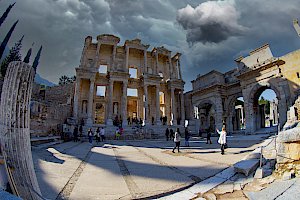
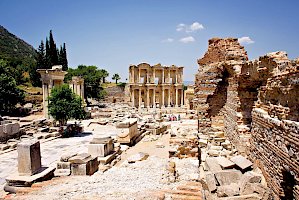
One of the most iconic discoveries in Ephesus, the Library of Celsus was built in honor of Tiberius Julius Celsus Polemaeanus, a Roman senator. Uncovered by Austrian archaeologists, the library’s grand façade has been meticulously reconstructed and is a testament to Roman architectural elegance.
2. The Great Theatre
The excavation of the Great Theatre revealed a structure capable of seating 25,000 people, making it one of the largest theatres of the ancient world. Carved into Mount Pion, the theatre was used for entertainment, public gatherings, and possibly religious events. Its acoustics and scale reflect the city’s prominence during Roman times.
3. The Terrace Houses
Also known as the “houses of the rich,” the Terrace Houses were uncovered during ongoing excavations and offer insight into the lifestyles of Ephesus’s elite. These multi-level homes feature mosaics, frescoes, and an advanced heating system, illustrating the sophistication of domestic life in ancient Ephesus.
4. The Temple of Hadrian and Other Structures
Numerous temples, including the Temple of Hadrian, fountains, and public baths, have been uncovered over the years, providing a well-rounded picture of religious and social life in the city. Each discovery adds a new layer to the understanding of Ephesus’s historical and cultural context.
The Importance of Ephesus as a UNESCO World Heritage Site
In 2015, Ephesus was officially recognized as a UNESCO World Heritage Site, a designation that acknowledges its historical, cultural, and architectural significance. This recognition has helped ensure that conservation efforts are in place to protect the site for future generations. Ephesus’s importance extends beyond its ruins; it is a place where history, religion, and culture intersect, making it a key location for historians, archaeologists, and travelers alike. Today, Ephesus is visited by millions of tourists each year, who come to explore its well-preserved streets, grand buildings, and religious sites. Guided tours are available through services like ephesustours.biz, which offer visitors a deeper understanding of the city’s legacy and ongoing archaeological work.
Future Prospects for Archaeology in Ephesus
Ephesus remains a focal point for archaeologists from around the world. Ongoing excavations continue to shed light on previously hidden aspects of the city’s layout, infrastructure, and daily life. As technology advances, archaeologists are optimistic about uncovering even more of Ephesus’s secrets. The city’s ancient harbor area, which played a vital role in its prosperity, is one such area of interest. Researchers hope to explore this and other areas with the aid of new technologies, revealing further details about Ephesus’s role as a major port city and cultural center in antiquity.
Visiting the Archaeological Site of Ephesus
If you’re planning to visit Ephesus, here are a few tips:
- Plan a Full Day: Ephesus is a large site with much to see, so allow yourself ample time to explore.
- Take a Guided Tour: A knowledgeable guide can enrich your experience with detailed stories about the site’s history and excavations.
- Visit Nearby Attractions: Don’t miss the House of the Virgin Mary and the Basilica of St. John, located nearby. These sites add further depth to the story of Ephesus as a religious and cultural landmark.
The rediscovery of Ephesus by modern archaeologists has brought the city’s ancient glory back into the world’s view. Each new excavation and discovery adds another chapter to the story of Ephesus, a city that time forgot but has never truly lost. Through the dedication of generations of archaeologists, Ephesus continues to inspire, educate, and remind us of the rich heritage that lies beneath the surface.